

What Is AI Predictive Analytics?
AI for predictive analytics is the application of artificial intelligence to forecast future outcomes from historical and real-time data. It combines data, mathematical algorithms, and automated reasoning to estimate probabilities. Predictive analytics leverages classification, regression, and time-series algorithms to reveal trends, anticipate events, and guide decisions at speed and scale.
The Role of Machine Learning and Data Models
Machine learning trains models on labelled or unlabeled historical data, capturing relationships between variables. The models generalize these patterns to new inputs. As feedback arrives, they retrain and reduce error through techniques such as stochastic gradient optimization and active learning, improving prediction reliability.
The AI Advantage in Predictive Analytics
AI analytics delivers higher accuracy, speed, and adaptability by learning from diverse data and continuously updating forecasts.

AI predictive analytics. Automates complex feature engineering for signals hidden in messy data.

Handles unstructured text, images, and streams alongside structured data, such as tables and logs.

Scales from thousands to billions of records without manual tuning.

Continuously retrained on outcome feedback to minimize model bias over time.
IDC reports that companies utilizing continuous learning pipelines are approximately 23% more effective at making accurate forecasts.
Why AI Predictive Analytics Matters in 2026?
AI for predictive analytics is crucial because markets are evolving at a faster pace, data volumes are increasing across multiple channels, and proactive decisions consistently outperform reactive responses. You gain early warnings, optimized operations, and fine-grained personalization. As regulations tighten and budgets shrink, accurate forecasting improves compliance, margin, and resilience.
The Shift from Reactive to Proactive Decision-Making
Organizations shift away from historical, descriptive reporting toward progressive action by emphasizing likely scenarios, quantifying risks, and suggesting interventions. AI and predictive analytics embed predictive alerts directly into operational workflows.
Real-Time Predictions for Faster Business Moves
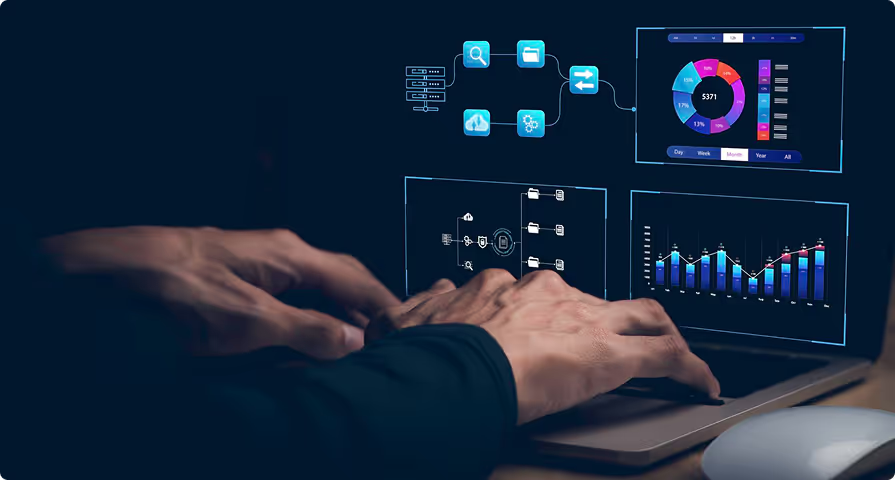
Streaming architectures enable low-latency scoring on events as they happen. AI-powered predictive analytics enables instant offers, dynamic pricing, fraud detection, and supply rerouting, reducing the time between signal and action. 75% of global enterprises now stream predictive scores in under five seconds (Gartner, 2025).
Competitive Edge and Cost Efficiency
Accurate forecasts minimize waste, optimize inventory, reduce churn, and prevent false positives. Predictive analytics improve planning accuracy, reduce manual analysis time, and concentrate spend on the highest-return activities, yielding a measurable advantage. Companies that use data to predict future outcomes and cut costs typically save 12–18% on expenses (Deloitte, 2025).
What Are the Key Components of AI Predictive Analytics Systems?
AI for predictive analytics systems combines versatile data pipelines, engineered features, scalable model training, and continuous monitoring to deliver accurate predictions. You can unify silos, provide trustworthy inputs, and operationalize models where decisions are made. Governance, observability, and feedback loops sustain accuracy and compliance.
Real-World Applications of AI Predictive Analytics
AI for predictive analytics converts historical and streaming data into targeted actions that reduce risk, lift revenue, and sharpen planning. It links probabilities to decisions, enabling teams to intervene earlier, allocate resources efficiently, and sustain performance under changing conditions.
Predicting Customer Behaviour and Sales
Growth teams use AI and predictive analytics to anticipate churn, conversion, and lifetime value, then trigger interventions that protect revenue and improve acquisition efficiency. Unified behavioural, transactional, and contextual signals reveal who will leave, who will buy next, and which incentive will move the needle now.

Retention teams identify customers at risk of churn and launch targeted save offers.

Sales teams score inbound leads and prioritize the highest-close opportunities.

Merchandisers forecast local demand and adjust stock levels to match projected orders.

Marketers personalize promotions and increase conversions without eroding margin.
AI predictive analytics can improve retention by up to 20% in the telecom industry (Forrester, 2025).
Financial Forecasting and Risk Management
Finance leaders apply AI and predictive analytics to strengthen planning accuracy, enforce controls, and contain losses. Real-time scoring on transactions and counterparties reduces fraud exposure, guides credit decisions, and positions liquidity where volatility rises before month-end cycles catch up.

Fraud systems detect anomalous transactions and block suspicious payments.

Treasury teams forecast cash flows and build buffers before crunches.

Credit analysts optimize limits and price risk using behavioural trends.

Risk managers stress-test portfolios and simulate shocks across scenarios.
Healthcare and Predictive Diagnostics
Clinicians and care managers rely on AI predictive analytics to spot early deterioration, personalize pathways, and optimize scarce staff time. Propensity and risk scores direct outreach, diagnostics, and scheduling, ensuring that high-risk patients receive timely interventions and avoid preventable readmissions.

Care teams flag readmission risk and schedule targeted follow-ups.

Physicians prioritize diagnostic and sequencing tests based on the likelihood of progression.

Schedulers predict no-shows and balance calendars with intelligent overbooking to ensure optimal utilization.

Triage nurses escalate cases that are deteriorating and expedite emergency responses.
Manufacturing and Supply Chain Optimization
Operations leaders embed AI for predictive analytics to stabilize throughput, prevent downtime, and protect service levels. Forecasts of failures, supplier delays, and transport risks drive proactive maintenance, balanced inventory, and dynamic routing, preventing small issues from cascading into costly disruptions.

Maintenance teams predict machine failures and plan preventive service windows.

Procurement teams forecast supplier delays and diversify order allocations.

Planners optimize safety stock and set buffers by variability.

Logistics teams reroute shipments and meet SLAs despite disruptions.
AI predictive analytics can improve retention by up to 20% in the telecom industry (Forrester, 2025).
How to Use Generative AI in Data Analytics?
You can use generative AI to accelerate discovery, feature ideation, and documentation. It retains human accountability for validation, governance, and strategic decision-making. You can frame problems precisely, safeguard data, review outputs rigorously, and translate insights into actions that deliver measurable value.

Stakeholders define the problem, metric, constraints, and the success criteria.

Data stewards inventory sources and document access, as well as lineage and quality rules.

Analysts prompt for candidate features and propose labels and windows.

Engineers generate SQL queries and notebooks, and hard-code tests.

Owners auto-document pipelines and publish model cards and runbooks.

Leaders craft narratives and scenarios, aligning actions with strategy.

How AI Will Impact the Future of Data Analytics?
AI predictive analytics will intensify speed, scale, and precision as data volumes expand and latency expectations decrease, shaping the future of data analytics. There will be unified platforms where discovery, modelling, and activation converge. Governance, interpretability, and human oversight will continue to be essential.
Smarter, Faster, and More Predictive Analytics
Foundation models will enrich tabular data with text, vision, and sensor context. AI and predictive analytics will continuously update forecasts, shrinking decision cycles and enabling granular optimization without sacrificing auditability.
The Rise of Autonomous and Real-Time Data Systems
Event-driven architectures will embed AI directly into streams for predictive analytics. Systems will automatically tune resources, retrain models, and push policies to the edge, enabling low-latency actions across distributed operations.
Will AI Impact Data Analytics?
AI will not replace data analytics; it will amplify analysts by automating work while humans frame questions, validate assumptions, and align predictions with strategy and ethics.
Final Words

AI for predictive analytics turns data into timely, actionable foresight.

There is governance, monitoring, and calibration, which safeguard results and trust.

Native pipelines, features, and models maintain accuracy at scale.

Live scoring helps to make quicker moves and fewer surprises.

Generative AI is a faster analytics system, though humans must supervise it.

Strategy, not tooling, ultimately determines the value of forecasting.
FAQ’s
AI predictive analytics differs from traditional forecasting because it learns nonlinear patterns from streaming, diverse data and continuously updates for real-time, individualized predictions. Classical approaches rely on fixed assumptions, smaller samples, and scheduled updates, which lead to slowness, a rougher understanding, and limited flexibility.
The most effective industries for AI analytics are finance, retail, healthcare, manufacturing, logistics, telecommunications, energy, and public services. Common wins include fraud prevention, demand forecasting, preventive maintenance, network optimization, triage prioritization, and citizen service planning.
Small businesses can utilize AI analytics affordably through the use of usage-based cloud services, pre-built models, and automation. Start with one revenue-linked case, validate ROI, then expand with lightweight governance.
Predictive models based on AI are effective when data quality is high, the problem under consideration is well framed, and the system is stable. Measure with AUC, F1, MAPE, or uplift; monitor drift and retrain regularly.
AI will not eliminate data analytics jobs, as automation will supplement human analysts, with humans formulating problems, and converting predictions into actionable strategic decisions. Roles shift toward product thinking, validation, communication, and ethical oversight as AI for predictive analytics scales.
Try Reporting Hub free for 30 days
Deploy to your own Azure environment with the self-serve guided installer and be live in minutes — BI Genius Starter included on every plan.