





In 2026, the analytics landscape is undergoing a shift as significant as the rise of cloud computing a decade ago. For SaaS companies, enterprises, and analytics service providers, data is no longer a supporting capability hidden behind product features. It has become a competitive differentiator, a revenue driver, and increasingly, the center of customer value.
But something even more transformative is happening. Embedded analytics is converging with generative AI, and this convergence is reshaping how software is built, how insights are delivered, and how analytics becomes a monetizable product instead of an operational cost.
Across the industry, and reflected in forward-looking trends, one message is clear:
The next wave of growth for SaaS companies and analytics teams will come from packaging, personalizing, and productizing data.
Customers don’t just want charts. They want answers. They want context. They want personalized narratives. And they want analytics that feel like part of the product; not an afterthought.
This is why the partnership between embedded BI and generative AI is becoming the most valuable technology combination.
The New Reality: Insight, Not Interfaces
Dashboards used to be the main event. For years, BI success was measured by how cleanly a team could visualize KPIs. Today, visuals are still important, but users want something deeper: intelligence that meets them where they are.
Generative AI has changed expectations permanently. A user who can ask ChatGPT a complex question in plain English will naturally expect the same inside the tools they use for work.
.png)
The question is no longer:
“Where do I find this metric?”

It has become:
“Explain why this metric changed and recommend what I should do next.”
This is exactly the gap where BI Genius sits – allowing organizations to configure AI agents that read metadata from Power BI semantic models, SQL databases, or other connected data sources. These agents provide contextual answers, generate consistent, rule-guided explanations, and surface insights that used to require an analyst.
What makes this powerful is not just the natural language interface, but the governance behind it.
BI Genius ensures every AI insight is:
 Traceable
 Explainable
 Consistent with business rules
 Aligned with semantic models
In other words, it feels like generative AI, but behaves like enterprise BI.
Why Embedded Analytics Is Becoming the New Revenue Engine
At the same time, AI is reshaping insight delivery, and embedded analytics is reshaping product strategy.

SaaS leaders have shifted their perspective dramatically. Where analytics used to be a checkbox feature, today it is one of the most monetizable components of a product roadmap. Reporting Hub reinforces this shift by making it dramatically faster and easier for teams to scale analytics to customers without building a custom platform from scratch.
Reporting Hub’s biggest contribution to SaaS teams is the collapse of time-to-market. A fully white-labeled, multi-tenant analytics environment that previously took months of development can now be deployed in minutes directly into an Azure environment when deployed inside a pre-configured Azure subscription.
Instead of teams spending engineering cycles on authentication systems, capacity management, or Power BI Embedded setup (capacity, embed tokens, workspace bindings), Reporting Hub provides the entire delivery layer – branded, secure, and ready to scale.
This is what unlocks monetization. When analytics delivery becomes simple, product leaders can finally price, package, and sell analytics strategically.
Many SaaS companies are already doing exactly that by launching:
 Premium analytics tiers
 Data products for partners
 Industry-specific dashboards
 White-label client portals
 AI-powered report subscriptions
The opportunity is no longer hypothetical. It’s here – and it’s accelerating.
Generative AI Completes the Embedded Analytics Story
Until recently, embedded analytics still required a level of user interpretation. Even with clean dashboards, customers needed an understanding of what the numbers meant. Generative AI removes this barrier by becoming the interpreter.
BI Genius takes this further by bringing structure and accountability to AI-driven analytics. Its explainability framework turns AI into a reliable partner rather than a black box. Administrators can see how the AI arrived at an answer, what DAX logic the AI referenced or generated under governed constraints, and which semantic model elements were applied.
This level of transparency is essential in 2026, where leaders increasingly demand:
 Trustworthy insights
 Compliant AI usage
Alignment with business definitions
Predictable outputs
Compliant AI usage
Alignment with business definitions
Predictable outputs
AI cannot be a mystery. It must be governed. BI Genius ensures that generative AI becomes an enhancement to BI, not a risk.
When paired with Reporting Hub as the distribution layer, SaaS companies can deliver AI-powered insights at scale, embedded directly into their products or portals, with no compromise on security or tenant isolation when implemented with RLS and token-scoped isolation.

Monetization Looks Different in 2026 – and Better
One of the biggest shifts happening this year is the diversification of analytics monetization models.
Organizations are no longer limited to “give analytics for free” or “charge for dashboards.” With the combination of embedded analytics and AI, teams are unlocking entirely new product formats, including packaged insights, AI-generated summaries, and on-demand explanations that customers will pay for.
The most common revenue models emerging include:

Premium analytics tiers
Companies introduce higher-priced plans with richer insights, predictive metrics, or AI-powered narratives.

Client-facing data portals
Enterprises and SaaS teams use Reporting Hub to share secure analytics with partners, franchises, suppliers, or customers.

White-label analytics products
BI consultants and agencies package industry dashboards and sell them as recurring subscriptions.

Tenant-based pricing
Multi-tenant SaaS products charge customers for their own analytics environment, with Reporting Hub acting as the scalable delivery layer.

AI insight subscriptions
BI Genius enables automated summaries, root-cause hypothesis explanations, and question-and-answer capabilities that can be sold as add-ons.

Specialized vertical data products
Manufacturing, healthcare, finance, retail, and logistics teams are building actionable analytics modules tailored to their sectors.
What makes these models viable is not just AI. It’s the combination of AI and embedded BI infrastructure – the delivery platform and the intelligence layer working as one.
Why 2026 Requires a Different Architecture
The analytics stack of 2026 is not the same as the analytics stack of 2018. Organizations need more flexibility, more integration options, and more scalability.
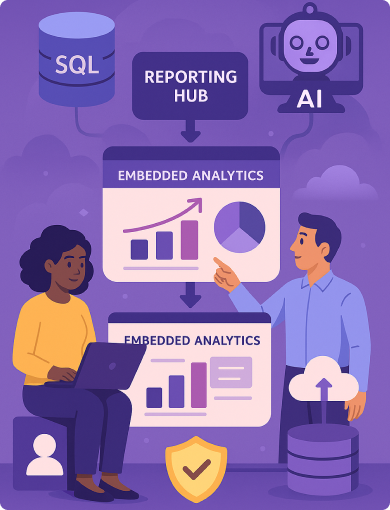
A modern monetizable architecture typically includes:
- Reporting Hub as the embedded analytics delivery platform
- Power BI Embedded as the visualization engine
- BI Genius as the generative AI and explainability layer
- SQL, APIs, Direct Lake / Fabric OneLake, and cloud data warehouses as source inputs
- Enterprise or customer identity providers (Azure AD, Azure AD B2C)
- Multi-tenant controls for client-by-client isolation
- Semantic model governance for consistent logic
This architecture creates something extremely valuable: a data product that is fast to deploy, scalable to maintain, and easy to monetize.
Teams that previously hesitated to sell analytics are now turning analytics into one of their most profitable product lines.
The Human Side: Why Customers Are Willing to Pay More
One of the most important dynamics is that customers, regardless of industry, are facing data overload. They have more dashboards, more metrics, and more sources than ever before.
What they don’t have is clarity.
The real monetization opportunity isn’t in giving customers more data. It’s in giving them:
 Prioritized insights
 Contextual explanations
 Trend analysis
 Guided decision support
 Personalized recommendations
Generative AI is the perfect medium for delivering these experiences, but only when it is anchored in a transparent, explainable, governed BI framework. This is where BI Genius stands out: it aligns AI with business rules, definitions, and semantic models so insights are both accurate and trusted.
Reporting Hub completes the experience by making these insights accessible through a branded, streamlined, user-friendly delivery layer.
Together, they turn analytics from “something you check” into “something that informs everything you do.”

From Cost Center to Product Line
For many organizations, analytics has historically been expensive, complex, and difficult to scale. Power BI licensing alone often prevented external sharing or unlimited customer access, which is why Reporting Hub’s ability to support virtually unlimited users (capacity-based, not per-user licensed) and external audiences has become a major turning point for SaaS teams.
Once you remove licensing friction, simplify delivery, and layer in AI-powered intelligence, analytics stops being a cost center. It becomes a revenue engine with predictable margin and scalable growth.
Some SaaS companies are now seeing analytics contribute:
 New ARR from premium tiers
 Expanded contract value from enterprise accounts
 Retention improvements due to deeper product engagement
 New cross-sell opportunities
 New standalone data products
 Competitive wins due to differentiation
This is why 2026 is the year analytics becomes a core part of product strategy, not just data strategy.
The Future of Analytics Is Fast, Embedded, and AI-Driven
The convergence of embedded analytics and generative AI marks a profound shift in how software creates value. It is giving SaaS companies the ability to launch analytics products in days instead of months, while delivering intelligence that used to require a dedicated analyst.

Reporting Hub provides the infrastructure that makes this possible. BI Genius provides the AI layer that turns data into decisions.
The result is a modern analytics experience where insight is:
- Near-instant
- contextual
- explainable
- governable
- scalable
- and ready to monetize
Ready to See What’s Possible?